
Every few years, a Kyoto city council tightens tourist access to a geisha district, and every few years the same headline runs somewhere: “Japan cracks down on geisha prostitution.” It isn’t. It never was, technically – and the fact that Western readers still reach for that word says more about a few decades of orientalist fiction than about what a geisha actually does for a living.
That confusion is a useful place to start, because it’s really a question about companionship itself: which societies have paid, historically and today, for company rather than sex, how they’ve drawn that line, and what happens once the line gets blurred on purpose.
The geisha and the modern escort get lumped together constantly. They shouldn’t be, and looking at why tells you more about companionship culture worldwide than a straight history lesson would.

The word doesn’t mean what a decade of novels said it means
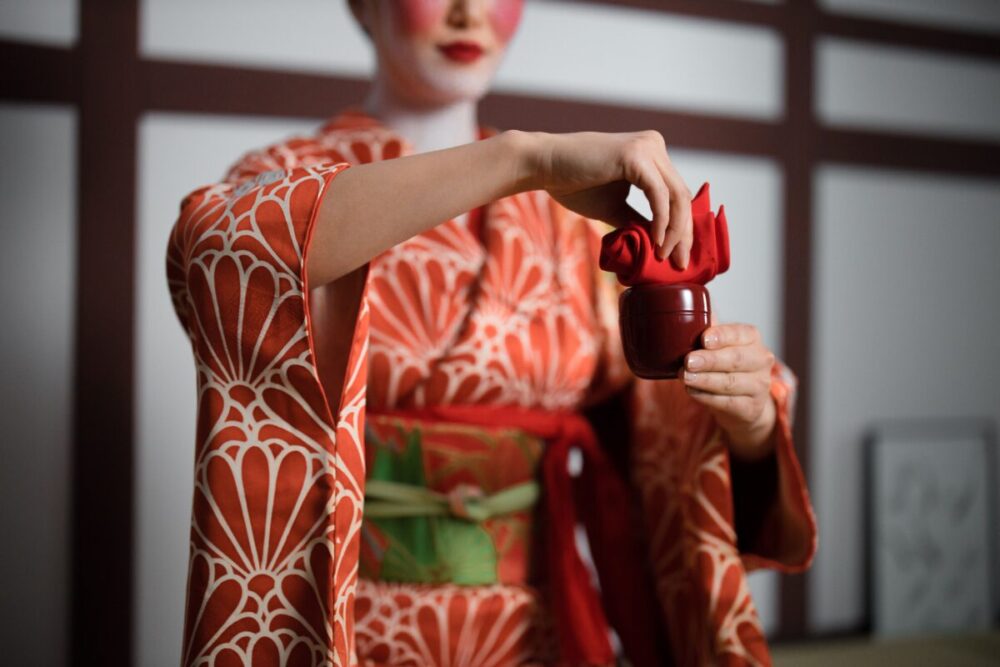
Geisha (芸者) breaks down to “art person.” The first character, gei, is the same one in the words for art, artist, and performing arts generally – it has nothing to do with intimacy and everything to do with training.
Maki Isaka, a professor of Japanese performance and gender studies at the University of Minnesota, put it plainly to National Geographic in 2024: the modern image of the geisha “is rather irregular when we try historicizing the term.”
The confusion has a specific origin, too – she names it as decades of Western sexualization, amplified by novels like Memoirs of a Geisha, layered on top of a profession that actually emerged as a deliberate legal alternative to prostitution.
In Edo-period Japan, the licensed pleasure quarters ran two parallel tracks. Courtesans – oiran, tayū – sold sex, ranked in a formal hierarchy, some commanding fees equivalent to well over ¥100,000 in today’s money for a single night, according to historical records collected by Nippon.com’s history of Yoshiwara’s courtesans.
Geisha did something else: they played shamisen, sang, danced, made conversation, and were, under shogunate edict, explicitly forbidden from selling sex.
Their dress code even signaled the difference – geisha wore a plain woven obi tied at the back, deliberately unglamorous next to an oiran’s ornate front-tied sash, so a customer could tell the two apart at a glance.
Some geisha broke that rule anyway, and some historically did sex work under coercion, which is worth saying plainly rather than romanticizing away.
But the profession’s entire legal and cultural design was a two-track system: art on one side, sex for sale on the other, kept structurally separate.
Nearly every culture built the same two-track system – then colonialism erased it
This isn’t a Japan-only story. Look at North India’s tawaif, women trained for years in Kathak dance, Urdu poetry, and etiquette, who were sent aristocratic sons to educate in manners and language, and who held real political influence in royal courts.
Or the qiyan of the Abbasid Islamic world – enslaved and free women trained in poetry, calligraphy, and music, so directly comparable to geisha that Wikipedia’s own entry on them cites scholars calling geisha “the most comparable form of socially institutionalized female companionship” outside the Islamic world.
Renaissance Venice had its own courtesans who were poets and musicians first, celebrities of their era. None of these were identical systems – the qiyan were frequently enslaved, the tawaif were free women with property rights, the geisha ran an almost entirely female-owned business hierarchy – but the pattern repeats: sophisticated, high-status, artistically trained female companionship, distinguished culturally and often legally from sex work.
Then European colonial administrators arrived and, more often than not, refused to see the distinction. India’s tawaif tradition was gutted by the “anti-nautch movement” starting around 1892, when Victorian morality campaigners branded court dancers and courtesans as simply prostitutes, stripping them of patronage and pushing many into the exact trade they’d been accused of.
A century-spanning art form collapsed largely because outsiders declined to believe a two-track system could exist. It’s a pattern worth sitting with: the “West conflates companionship with sex work” problem isn’t just modern sloppiness – it has actual policy history, and actual casualties.

The 20th century flattened all of it into one legal category – then split it back apart
What’s genuinely modern isn’t paid companionship – every culture above proves that’s ancient. What’s modern is treating “paid companionship” and “sex work” as a single administrative category that a government has to legislate on directly, rather than a social distinction enforced by custom and dress codes. And once lawmakers picked up the pen, they went in wildly different directions.
| Country / region | Legal model | Core law | What’s actually prohibited |
|---|---|---|---|
| Germany | Regulation / legalization | Prostitution Act (2002), Prostitutes Protection Act (2017) | Unlicensed businesses, coercion, minors; buying and selling itself is a registered occupation |
| Netherlands | Decriminalization with licensing | Brothel ban lifted 1 October 2000 | Coercion, trafficking, unlicensed brothels; voluntary adult sex work is not a crime |
| Sweden / Norway | “Nordic model” | Sex Purchase Act, 1999 (Sweden); 2009 (Norway) | Buying sex is a crime; selling it is not |
| France / Ireland | Nordic model (adopted later) | 2016 (France) / 2017 (Ireland) | Buying sex; both switched from a previously legal regime |
| Belgium | Full decriminalization | 2022 reform | Trafficking and exploitation only; even third-party involvement is decriminalized |
| Most of the United States | Criminalization | Varies by state; Nevada exception | Buying and selling both, outside licensed Nevada counties |
Sources: European Parliament Research Service, “Regulation of Prostitution in the European Union” (2024); Dutch government brothel-ban records; national legislation as cited. Figures current as of mid-2026.
Notice what the table actually shows: five wealthy, broadly liberal democracies looked at the same underlying activity and reached five different conclusions about what the law should even be trying to do.
Germany and the Netherlands treat it as ordinary labor that needs regulation. Sweden treats it as violence against women that needs to be starved of demand.
Belgium treats it as none of the state’s business except where coercion enters. That’s not a minor technical disagreement – those are fundamentally incompatible theories of what’s actually happening when money changes hands for company and intimacy.
Germany went furthest in treating it as an ordinary industry
Germany’s approach is the most thoroughly bureaucratized on the list. The 2002 Prostitution Act gave sex workers enforceable contract rights – wages could no longer be denied on the grounds that the underlying work was “immoral.”
The 2017 Prostitutes Protection Act layered on registration, mandatory health counseling, and a licensing requirement for any prostitution business, a category the law defines explicitly to include escort agencies (Escortvermittlungen) alongside brothels and prostitution vehicles.
Operating without a permit is punishable by a fine of up to €10,000. Registered sex workers get access to Germany’s statutory health insurance system, and self-employed workers earning above roughly €77,400 a year (the 2026 private-insurance threshold) can opt for private coverage instead, exactly as any other self-employed professional would.
In practice, this means a licensed escort München agency has to satisfy the same permitting regime as a brothel in Hamburg or a call-girl service in Berlin – business concept, tax registration, condom-requirement signage, the works.
That’s a genuinely unusual level of normalization by global standards; most countries either criminalize the whole arrangement or tolerate it in a gray zone. It’s also, by most independent accounts, an incomplete solution: legal analysts have noted that a brothel or agency operating with a valid permit can still be prosecuted separately if operators are exploiting workers behind that legal facade – the licensing system makes exploitation easier to detect on paper, not impossible in practice.
The Nordic countries bet on the opposite theory – and have real numbers to show for it
Sweden’s 1999 law was the first in the world to criminalize buying sex while leaving selling it legal, built on the explicit premise that prostitution constitutes violence against women and that reducing male demand is the correct lever to pull. Norway followed in 2009.
The evidence that’s accumulated since is more interesting than either side’s talking points suggest. A 2023 study in the European Journal of Law and Economics found that the share of Norwegians who said they knew someone who’d bought sex in the past six months fell from roughly 10% before the 2009 law to about 5% by 2014 – a genuine, measurable drop that tracked the legal change specifically, using a difference-in-differences design to rule out a general trend. Sweden’s own numbers stayed comparatively flat over the same stretch.
That’s a real result, not a talking point, and I don’t think it’s fair to wave it away just because it’s inconvenient for the labor-rights side of this argument.
Sweden has also kept legislating: in May 2025 its parliament voted to extend the purchase ban to paying for sexual acts online, covering platforms like OnlyFans, effective July 2025 – explicitly because police reported that sugar-dating sites were functioning as a pipeline into offline prostitution for young women.
The strongest version of the abolitionist case doesn’t come from a government report, though – it comes from the people it’s meant to protect. Writing for the advocacy site Nordic Model Now in 2026, a woman describing her own trafficking as a teenager into what was marketed as a “high-class escort agency” argued that the industry’s most-praised innovation, the girlfriend experience, is really just a euphemism for compelled emotional labor:
“You are expected to smile. To pretend you enjoy it… What is being bought is not simply sex. What is being bought is the fantasy that he is the centre of the universe.” Whatever you think of the Nordic model as policy, that’s a serious argument from someone with direct experience of the thing being debated, and it deserves to be engaged with rather than dismissed.
Meanwhile, “the girlfriend experience” became the industry’s most profitable idea
Set the legal debate aside for a second and look at where the money is actually going, because it complicates both sides of that argument. The commercial companionship industry’s biggest recent shift isn’t about sex at all – it’s about attention.
A 2025 report from Supercreator, a platform that helps manage OnlyFans accounts, found that 78% of messages from the platform’s highest-spending subscribers weren’t sexual in content – they were about pets, work stress, and small talk.
Only 15% were explicitly sexual. One creator, Sophie Rain, told the outlet her single highest-paying fan had spent over $6 million across two years, talking to her daily, “rarely” asking for nudity.
The academic term for this, coined well before OnlyFans existed, is the “girlfriend experience” (GFE) – sociologist Elizabeth Bernstein’s research frames it as a distinct form of commercial emotional labor, and a 2011 qualitative study by researcher M.D. Huff found that in-person GFE clients were seeking a sense of being wanted and needed nearly as much as sex itself.

My honest read on this: the girlfriend experience isn’t a new invention so much as the industry finally admitting what geisha, tawaif, and qiyan clients were often actually paying for all along – attention, flattery, the feeling of being the most important person in a room. The difference is that platforms now let you buy an unbundled version of it, stripped of the artistry those older traditions required years of training to produce.
Japan already had a fully non-sexual version of this – and it’s older than OnlyFans
Strip the sex out of “paid companionship” entirely and you land on Japan’s rental-friend industry, which has nothing to do with escort work by design. Entrepreneur Satsuki Oiwa founded the Japan Efficiency Corporation in 1991, initially to train corporate staff; within a few years it pivoted to renting out actors as sympathetic listeners for hire.
By 2009 there were reportedly ten “family rental” businesses operating in Japan, the largest being Family Romance. Shoji Morimoto, who has spent seven and a half years as a professional “rental person,” charges up to ¥30,000 (about £140) to accompany strangers to picnics, help with chores, or simply sit with someone through a bad day, under one strict rule: no romantic or sexual content, ever. He’s written a memoir about it, Rental Person Who Does Nothing.
That model has spread – to South Korea, where an “oppa” can be hired as an attractive older companion, and to China, per reporting in The Observer earlier this year – but Britain’s own attempt at the same idea has, by several accounts, struggled to keep the line intact.
One British “rental friend” told the Observer he fielded requests ranging from wedding plus-ones to, within his first week, explicit propositions, despite advertising strictly non-sexual companionship.
The gap between “Japan’s wholesome version” and “the UK’s version” isn’t really about national character – it’s about whether the surrounding culture treats a companionship-for-hire platform as a legitimate, bounded service or as a thin cover for something else, and clients seem to test that boundary wherever the platform lets them.
Now AI is trying to sell the same thing without a human at all

The newest node on this same continuum doesn’t involve a person on the other end. AI companion apps – Replika being the best-known early example – let users design a persistent, always-available virtual partner, and the demand behind them tracks a real and separately documented trend: a 2021 survey by the Survey Center on American Life found 15% of male respondents reported having no close friends at all, up from just 3% in 1990.
A 2026 review in Evolutionary Psychological Science traces a direct line from in-person girlfriend-experience escorts, through OnlyFans-style paid chat, to AI companions, arguing all three tap the same underlying motivations: novelty, attention, and – crucially – control over a partner who can’t reject you.
I think that last point is the one worth taking seriously rather than dismissing as a tech-bro pitch. LushAI’s founder told Al Jazeera the appeal of an AI companion is precisely that “she” has no standards about a man’s looks or finances.
That’s not a neutral feature. A companion who can never say no isn’t really companionship in any of the senses that geisha, tawaif, or even a modern escort’s clients were historically paying for – it’s the fantasy of companionship with the friction, and the actual other person, removed.
Every tradition covered in this piece, from Edo-period Japan to a Berlin licensing office, still involved a real second person setting real limits. That’s arguably the one constant worth preserving, whichever legal model you think handles it best.
Quick answers, since people keep asking
Was a geisha ever the same thing as a prostitute?
No – geisha were legally and culturally distinguished from courtesans in Edo-period Japan, trained in music, dance, and conversation, and formally forbidden from selling sex, though the two roles blurred at times and the Western popular image conflates them anyway.
Is escort work legal in Germany?
Yes. It’s been legal since the 2002 Prostitution Act and has operated under a formal licensing and registration regime since the 2017 Prostitutes Protection Act, which explicitly covers escort agencies as a licensed business category.
Does criminalizing buyers (the Nordic model) actually reduce demand?
The best available evidence, from Norway’s 2009 law, suggests yes, at least on that narrow metric – but it doesn’t resolve the separate question of whether that improves welfare and safety for people still working in the trade, which remains contested.
How this article was put together

This piece drew on national-level legal texts and government sources (Germany’s ProstG and ProstSchG, Dutch parliamentary records on the 2000 brothel-ban reform, Sweden’s Sex Purchase Act and its 2025 amendment via the Library of Congress Global Legal Monitor), the European Parliament’s 2024 comparative research briefing on EU prostitution regulation, peer-reviewed research on Nordic-model outcomes and on the psychology of paid companionship, and journalism from National Geographic, Vice, Al Jazeera, and The Observer for the cultural and industry-trend material, all checked in August 2026.
Also read: Tips for Hiring Escort Service
Historical claims about geisha, tawaif, and qiyan draw on Nippon.com’s institutional history, Wikipedia’s sourced entries, and academic theses on courtesan traditions. Where sources on the Netherlands disagreed about dates, I used the earliest primary Dutch government record. I could not independently verify enforcement statistics for Germany’s licensing regime, so those claims are presented as reported by legal analysts rather than as audited fact. Legal frameworks referenced here change frequently; recheck before citing specific fines or thresholds after 2026.