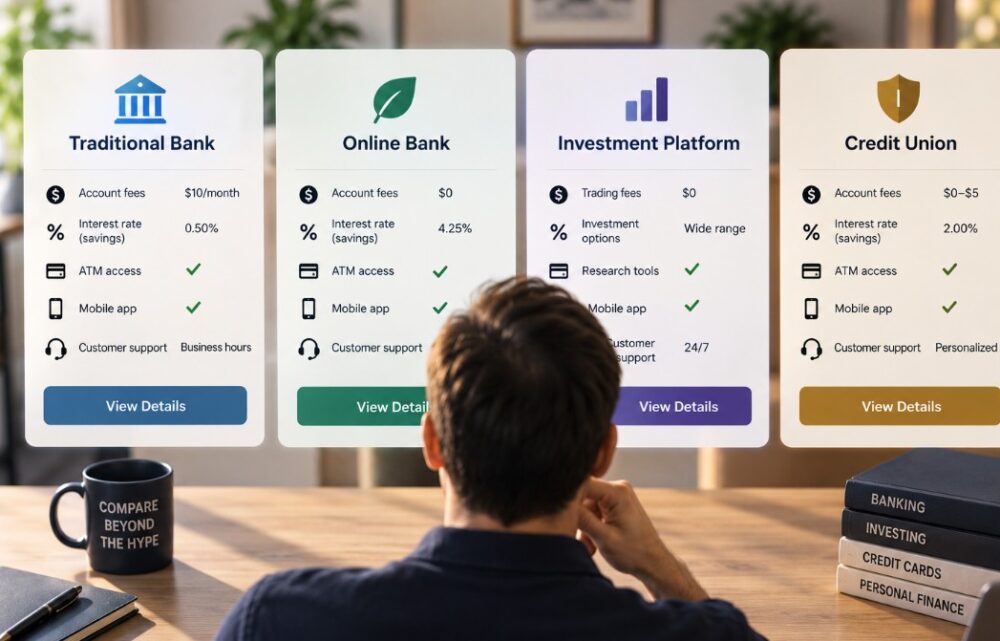
Choosing a financial service provider should feel boring. When it feels exciting, the marketing has done its job and the consumer has done less of theirs. The best comparisons happen when emotion is set aside and a small set of practical filters is applied consistently. Whether you are evaluating a credit card, a short-term funding option, or an online cash service, the same principles apply. What follows is a framework that holds up regardless of the category.
Start With What You Actually Need

Before comparing anything, articulate what problem you are solving. This sounds obvious, but most people skip it. They start by browsing offers, get drawn to whichever one looks most generous, and then justify the choice afterwards. Reverse the order. Write down the specific outcome you want: faster access to funds, lower fees on a recurring expense, better rewards for a particular category, or simply more predictable terms than what you have today.
Once the outcome is defined, every comparison becomes more efficient. Features that do not serve that outcome become noise. Promotional rates, limited-time bonuses, and cosmetic perks fall away. You are left with a smaller set of criteria that actually matter to your decision.
Read the Fine Print Before the Headline

Every financial service has a headline number. It might be an interest rate, a cashback percentage, a service fee, or a promotional bonus. Headlines are designed to attract. The actual cost of the service almost always lives somewhere else, in the fine print that explains when the headline applies, what triggers exceptions, and how the math changes once the introductory period ends.
A useful habit is to find the official terms document for any provider you are seriously considering, and read the sections about fees, penalties, and term changes first. If those sections are clear, well-organized, and easy to find, that already tells you something about how the provider treats customers. If those sections are buried, vague, or contradicted by promotional materials, treat that as a red flag and move on.
Verify Reputation Through Multiple Independent Sources

Reviews on a provider’s own website are not reviews. They are marketing. Real reputation lives in places the provider does not control: independent review platforms, consumer forums, regulatory complaint records, and conversations with people who have actually used the service for at least several months.
When you read reviews, pay less attention to the rating and more attention to the patterns in the complaints. A provider with a handful of common issues that get resolved quickly is usually more trustworthy than one with no complaints at all, because the absence of complaints often means the absence of meaningful volume. What you want to see is a provider that handles problems openly, communicates clearly, and does not disappear when customers reach out.
For specific categories like online cash services or short-term funding, comparison sites and a Korean resource called 카드깡 추천 can give you a starting point for understanding how the category typically operates, what fee structures are common, and which questions to ask before committing. Use them as one input among several, not as the final answer.
Test the Customer Experience Before You Commit

Most financial service providers offer some way to interact with them before you sign up: a contact form, a live chat, a phone line, or a public help center. Use these channels. Ask a specific, slightly inconvenient question, and see how the provider responds. The quality of pre-sale customer service is usually a good proxy for the quality of post-sale support.
A provider who answers clearly and patiently before they have your business will probably continue doing so afterwards. A provider who is hard to reach, scripted, or evasive during the sales process will not improve once you become a customer. This single test, applied consistently, eliminates more bad options than any spreadsheet of features ever will.
Compare Total Cost, Not Sticker Cost

The most common comparison mistake is anchoring on the most visible number. A lower rate is not automatically better if the service charges higher fees elsewhere. A larger bonus is not better if it requires behavior you would not otherwise undertake. The right comparison is total cost over a realistic time horizon, including all fees, interest, opportunity cost, and any behavioral changes the offer requires.
This is harder than comparing headlines, but it is the only comparison that actually predicts your experience as a customer. Build a simple table with three columns for each provider you are considering: what you pay, what you get, and what you give up. The provider whose table tells the most consistent story across all three is usually the one worth choosing.
Comparing financial service providers well is not about being skeptical of everyone. It is about being honest with yourself about what you need, patient enough to read what providers actually offer, and disciplined enough to walk away from offers that look better than they read. Done consistently, this approach turns financial decisions from gambles into routine, low-stress choices.